How Your Life Path Number Influences Career Choices
On this page
Introduction
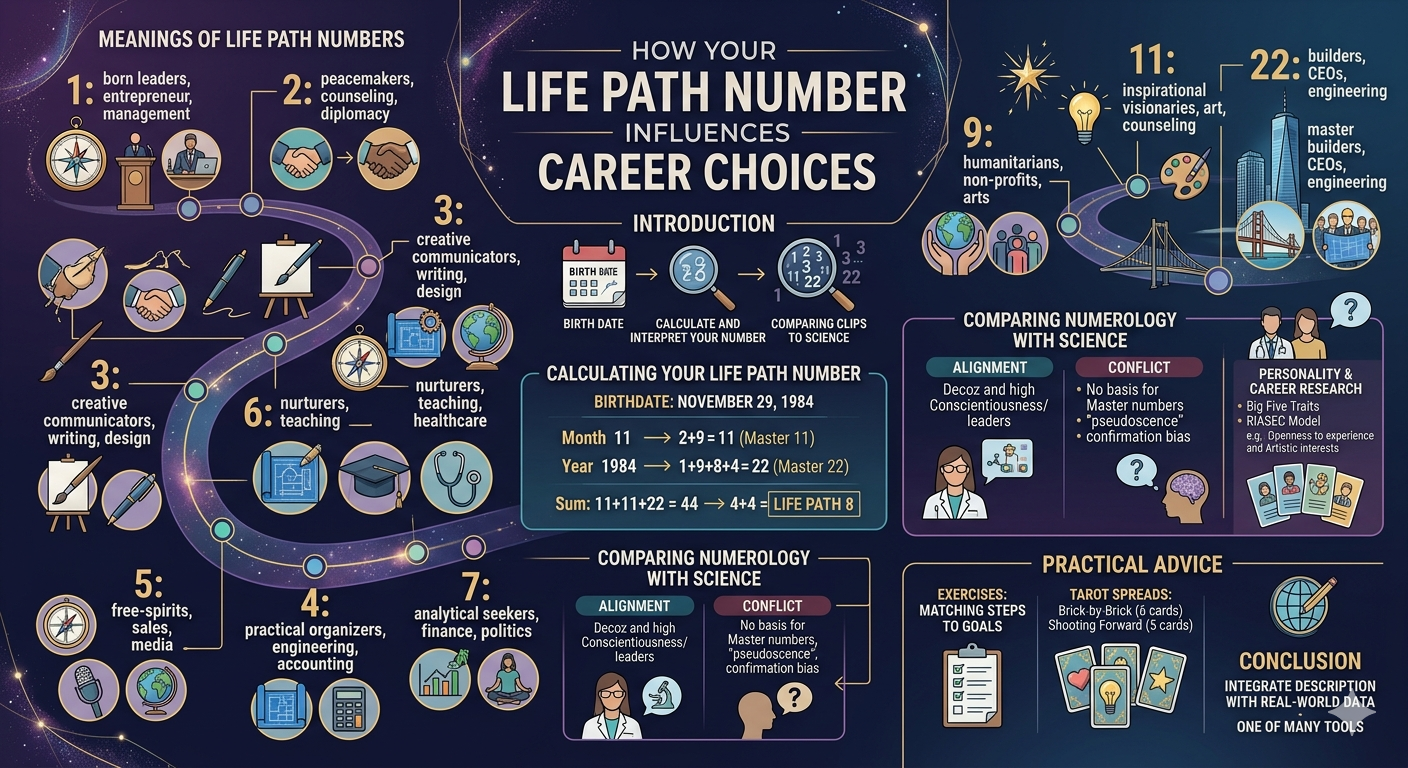
Your Life Path Number, derived from your birthdate, is thought in numerology to reflect your core nature. Proponents claim it influences career tendencies and strengths. This post explains how to calculate and interpret your Life Path, outlines traditional life path traits with career examples, and then compares these claims to scientific findings on personality and career choice. We highlight overlaps, such as leadership traits, and conflicts, noting numerology’s limitations (Africa Check, 2021). Finally, we offer practical tips, including exercises and tarot spreads, for using life-path insights responsibly in career planning (Decoz, n.d.; Labyrinthos Academy, n.d.).
Calculating Your Life Path Number
To find your number, use the digit-sum reduction method, while noting master numbers 11 and 22. For a birthdate of November 29, 1984:
- Month: 11 (Master 11)
- Day: 2+9 = 11 (Master 11)
- Year: 1+9+8+4 = 22 (Master 22)
- Sum: 11 + 11 + 22 = 44 \rightarrow 4+4 = 8
- Life Path: 8
Meanings of Life Path Numbers
According to traditional numerology (Decoz, n.d.):
- Life Path 1: Born leaders; ambitious, self-reliant. Careers: entrepreneur, management.
- Life Path 2: Peacemakers; sensitive team-players. Careers: counseling, diplomacy.
- Life Path 3: Creative communicators. Careers: writing, design.
- Life Path 4: Practical organizers. Careers: engineering, accounting.
- Life Path 5: Free-spirits, versatile. Careers: sales, media.
- Life Path 6: Nurturers, responsible. Careers: teaching, healthcare.
- Life Path 7: Analytical seekers. Careers: research, spirituality.
- Life Path 8: Business leaders. Careers: finance, politics.
- Life Path 9: Humanitarians. Careers: non-profits, arts.
- Life Path 11: Inspirational visionaries. Careers: art, counseling.
- Life Path 22: Master builders. Careers: CEOs, engineering.
Personality & Career Research
- Big Five Traits: Meta-analyses show that Conscientiousness and Emotional Stability are strong predictors of job performance (Barrick & Mount, 1991). Extraverts tend to excel in leadership and sales roles, mirroring "8" traits, while Agreeable types thrive in helping roles, similar to "6s" (Hurtz & Donovan, 2000).
- RIASEC Model: Holland’s model matches personality types to work environments. Realistic types prefer hands-on tasks (similar to Life Path 4), while Social types prioritize helping others (similar to Life Path 6). Research indicates that Investigative and Artistic interests correlate with high Openness, much like the creative "3" and "11" archetypes (PMC, 2022).
Comparing Numerology with Science
- Alignment: Practitioners suggest "1s" are driven leaders; similarly, psychologists find high Conscientiousness is a hallmark of effective leadership (Barrick & Mount, 1991; Decoz, n.d.).
- Conflict: Master numbers (11, 22) have no empirical basis in psychological literature. Fact-checkers note that numerology is categorized as a pseudoscience because it lacks reliable predictive ability (Africa Check, 2021).
- Biases: The perceived accuracy of numerology often stems from confirmation bias, where individuals remember hits and ignore misses (Africa Check, 2021).
Practical Advice
Use Life Path insights for self-reflection, but balance them with proven methods like career counseling and internships.
- Exercises: List jobs matching your Life Path strengths, then research their real-world requirements to set realistic goals.
- Tarot Spreads: Career-focused spreads, such as the Brick-by-Brick Spread (6 cards) or the Shooting Forward Spread (5 cards), can serve as meditative tools for identifying professional blocks (Labyrinthos Academy, n.d.).
Conclusion
Numerology’s Life Path offers interesting archetypes, but it lacks empirical support. Integrate your number’s description with real-world data; consider it one of many tools—alongside personality tests and vocational research—to help navigate your career path.
References
- Africa Check. (2021, October 19). The pseudoscience of numerology: Treating predictions as facts. https://africacheck.org/fact-checks/blog/pseudoscience-numerology-treating-predictions-facts
- Barrick, M. R., & Mount, M. K. (1991). The Big Five personality dimensions and job performance: A meta-analysis. Personnel Psychology, 44(1), 1–26. https://doi.org/10.1111/j.1744-6570.1991.tb00688.x
- Decoz, H. (n.d.). Life path numbers. World Numerology. https://www.worldnumerology.com/numerology-life-path
- Hurtz, G. M., & Donovan, J. J. (2000). Personality and job performance: The Big Five revisited. Journal of Applied Psychology, 85(6), 869–879. https://doi.org/10.1037/0021-9010.85.6.869
- Labyrinthos Academy. (n.d.). Three career tarot spreads for finding your path and calling. https://labyrinthos.co/blogs/learn-tarot-with-labyrinthos-academy/three-career-tarot-spreads-for-finding-your-path-and-calling
- PMC. (2022). Personality and person–work environment fit: A study based on the RIASEC model. PubMed Central. https://www.ncbi.nlm.nih.gov/pmc/articles/PMC9819525/